What Are ChatGPT Ads?
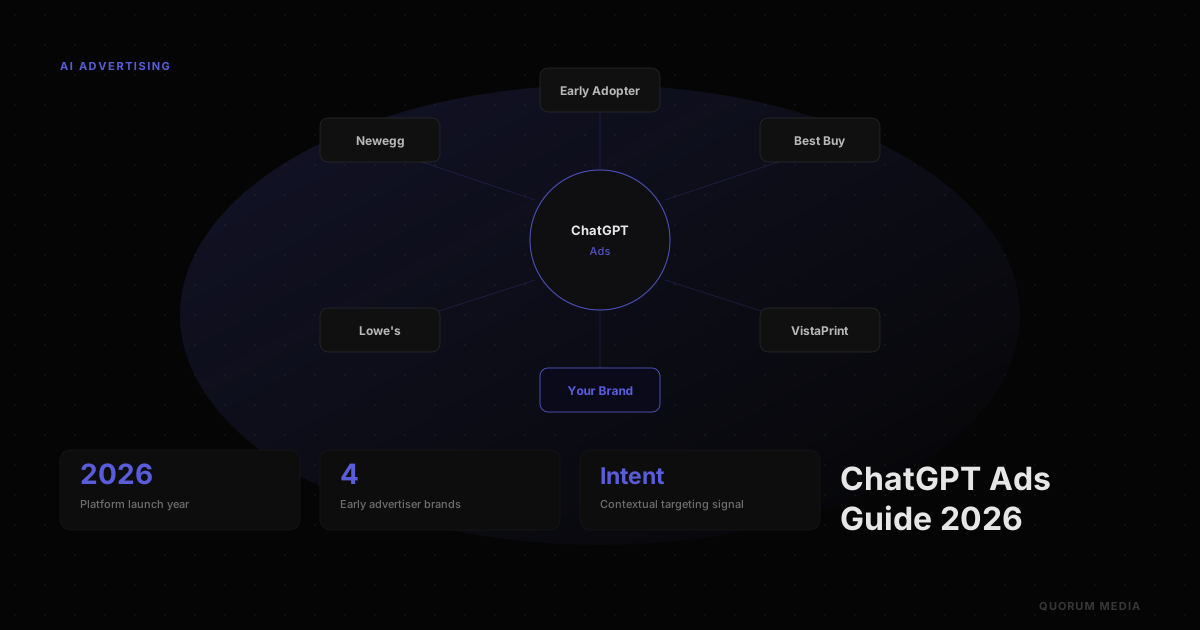
ChatGPT Ads are OpenAI's native advertising product, launched in 2026. Unlike traditional display or search advertising, they appear inside ChatGPT conversations rather than on a separate results page or in website banner slots. The ads surface when a user's conversation involves active research, comparison, or decision-making: the moments when purchase intent is highest and explicit.
Three design principles distinguish the product from conventional digital advertising. First, ads are clearly labeled inside the conversation so users always know they are seeing a paid placement. Second, they remain separate from ChatGPT's own responses: the AI's answer and the advertiser's message appear as distinct elements, and ChatGPT does not endorse or incorporate the ad into its own output. Third, users retain control over how their data is used in ad targeting, with settings available in their ChatGPT account.
The underlying premise is that advertising works best when it is genuinely useful to the person seeing it. A user researching which laptop to buy is more receptive to a relevant advertiser appearing in that conversation than to a banner interrupting an unrelated browsing session. ChatGPT Ads are built around that premise.

How ChatGPT Ads Work?
The targeting mechanism differs from search advertising in one important way: rather than matching ads to keywords, ChatGPT Ads match ads to conversational context. A two-word Google search gives the platform limited signal. A ChatGPT conversation gives it substantially more.
Consider the difference between a user typing "accounting software" into Google versus asking ChatGPT: "What accounting software would you recommend for a freelance designer in the UK who invoices in multiple currencies and needs HMRC-compatible VAT reporting?" The second query tells the platform the user's profession, location, specific use case, compliance requirements, and decision stage simultaneously. That context allows for ad matching that is harder to achieve through keyword targeting alone.
The flow works in three steps. The user asks ChatGPT a question that involves research, comparison, or evaluation. ChatGPT identifies the high-intent conversational context. An ad matched to that context appears in the conversation, labeled as a sponsored placement and kept separate from ChatGPT's own response.
Advertisers set up campaigns, budgets, and objectives through OpenAI's Ads Manager platform. Ad parameters can be configured directly in the tool or uploaded in bulk. Campaign performance is measured and reportable through the same interface.
Who Is Already Advertising on ChatGPT?
OpenAI's early advertiser roster reveals a clear pattern about which brands the platform suits. The companies that have already seen results share a common characteristic: their customers make decisions through research and comparison rather than impulse.
Newegg
Newegg, the technology retailer, was among the first advertisers to report results from the platform. Alec Shao, their Performance Marketing Manager, described the logic directly: "We want Newegg to be part of the conversation when someone is researching what to buy. Being in ChatGPT helps us shape engagement at that exact moment." Technology purchases — graphics cards, laptops, components, peripherals — are high-consideration decisions that users research extensively. ChatGPT is now a primary research tool for many of those decisions.
Best Buy
Consumer electronics purchases follow the same pattern: extended research, detailed comparison, and price sensitivity. Best Buy's customer base already uses digital tools heavily in the pre-purchase phase. Being present at the moment a user is asking ChatGPT to compare televisions or compare laptops is a natural extension of that behavior.
Lowe's
Home improvement purchases involve complex decision trees: material choices, compatibility questions, installation requirements, and budget trade-offs. Lowe's customers frequently ask detailed questions about products before purchasing. That research behavior maps directly to the conversational context ChatGPT Ads target.
VistaPrint
VistaPrint's core market is small and medium-sized businesses: a segment that uses AI assistants heavily for operational recommendations. An SMB owner asking ChatGPT for recommendations on business card printing, branded merchandise, or marketing materials is in exactly the intent state the platform is designed to capture.
The pattern across these early adopters: brands where the purchase decision involves genuine research, comparison across alternatives, and a clear answer to the question "which one should I choose?" If your product or service sits in that decision category, the platform is structurally suited to it.
ChatGPT Advertising, managed.
Campaign strategy, ad copy, setup, and ongoing management for brands running ads on ChatGPT. We handle the platform so you can focus on the results.
See the service →What Makes a Good ChatGPT Ad?
ChatGPT users are in a deliberate research state. They have opened a chat interface, typed out a detailed question, and are reading a considered response. They are not passively scrolling a social feed or glancing at a sidebar. The attention mode is different, and effective ChatGPT ad copy reflects that difference.
Several principles apply:
- Lead with the use case, not the brand name. "For freelancers comparing invoicing tools, FreshBooks offers..." outperforms "FreshBooks is the leading invoicing platform for..." because it signals immediately to the reader that this placement is relevant to their specific situation.
- State the differentiator clearly. Users in comparison mode want to know what makes one option different from another. A vague value proposition ("the best in class") provides less useful signal than a specific one ("the only platform with built-in HMRC VAT reporting for UK freelancers").
- Keep copy concise and direct. The conversational environment favors clarity. Long ad copy competes for attention with a detailed AI response. Shorter, more precise messaging performs better in the format.
- Match the register of the conversation. ChatGPT conversations tend to be informational and practical. Ad copy that matches that register feels native to the environment; promotional language that reads like a TV commercial does not.
An ad that feels like a useful, relevant recommendation will outperform one that feels like an interruption. The format rewards brands that can articulate genuine value in specific terms.
How Do ChatGPT Ads Compare to Google Ads and Social Advertising?
ChatGPT Ads do not replace existing digital advertising channels. They add a new layer that captures a distinct moment in the buyer journey. Understanding where the three major channel types differ helps clarify where ChatGPT Ads fit in a media mix.
- Google Ads: keyword-based intent targeting, broad audience reach, highly competitive CPCs in most categories, proven measurement infrastructure, mature optimization tooling. Best for capturing existing demand at the keyword level.
- Social Ads (Meta, LinkedIn): demographic and interest-based targeting, suited to awareness and discovery, lower explicit intent than search, strong for B2B and career-adjacent categories on LinkedIn. Best for reaching audiences before they are actively searching.
- ChatGPT Ads: conversational context targeting, explicit multi-signal intent from the user's own words, newer platform with substantially lower competition and CPCs, different creative requirements, emerging measurement. Best for capturing high-intent research conversations at the moment of comparison.
For most brands, ChatGPT Ads will complement rather than compete with Google and social channels. The buyer journey has multiple stages, and each channel is better suited to different ones. ChatGPT Ads are particularly well matched to the consideration and evaluation stages, where a user has already identified a problem and is researching solutions.
How Do ChatGPT Ads Fit Into Your AI Visibility Strategy?
There are two distinct ways a brand can appear in ChatGPT: organically and through paid placement. Understanding the difference matters for how you allocate resources.
Organic AI visibility means appearing in ChatGPT's own responses when the AI recommends or mentions your brand based on its training data and real-time search capabilities. This is the domain of AEO (Answer Engine Optimization) and GEO (Generative Engine Optimization): structuring your content, authority signals, and brand mentions so that AI models are more likely to surface you organically. Organic visibility is valuable but unpredictable. ChatGPT decides what to include in its responses, and those decisions are not directly controlled by advertisers.
Paid placement through ChatGPT Ads gives brands a controllable, measurable presence in high-intent conversations. You set the targeting criteria, the budget, and the message. Performance is reported. Campaigns can be adjusted based on results. The placement is confirmed, not probabilistic.
For brands building an AI visibility strategy, ChatGPT Ads provides the paid layer alongside the organic work. For brands that have not yet invested in AEO or GEO, ChatGPT Ads is often the faster entry point into AI-assisted discovery.
How to Get Started with ChatGPT Advertising?
The self-serve path runs through OpenAI's Ads Manager at ads.openai.com. The setup process follows three stages: create a campaign with a budget and objective, configure ad parameters either directly in the tool or via bulk upload, then launch and track performance through the reporting dashboard.
OpenAI is currently offering a promotional credit for new advertisers: spend €500 and receive €500 in advertising credit. The offer runs until December 2026, which makes the entry cost for testing the platform lower than it will be once the promotion expires.
For brands that want managed campaigns rather than self-serve setup, Quorum Media handles the full process: strategy, ad copy, campaign setup, and ongoing optimization. See our ChatGPT advertising service.
ChatGPT Ads is a genuinely new advertising surface. The context signals are richer than keyword search, the competition is substantially lower than Google Ads in most categories, and the intent state of the user is clearly defined. For brands whose customers make decisions through research and comparison, it is a channel worth testing while the platform is still in its early adoption phase.
If you want to talk through whether the channel fits your category and how to approach the first campaign, get in touch with our team or read about our managed ChatGPT advertising service.