Why ChatGPT Advertising Requires a Different Strategic Approach?
Search advertising strategy is built around keywords and demographic segments. You identify what people type into a search bar, bid on those terms, and serve ads against that query. The proxy for intent is a keyword. The signal is thin.
ChatGPT advertising is built around conversational context and decision stages. Instead of asking "what keyword does my audience search?" the right question is: "what does my audience ask ChatGPT when they are comparing options in my category?" These are not the same question and they do not produce the same answers.
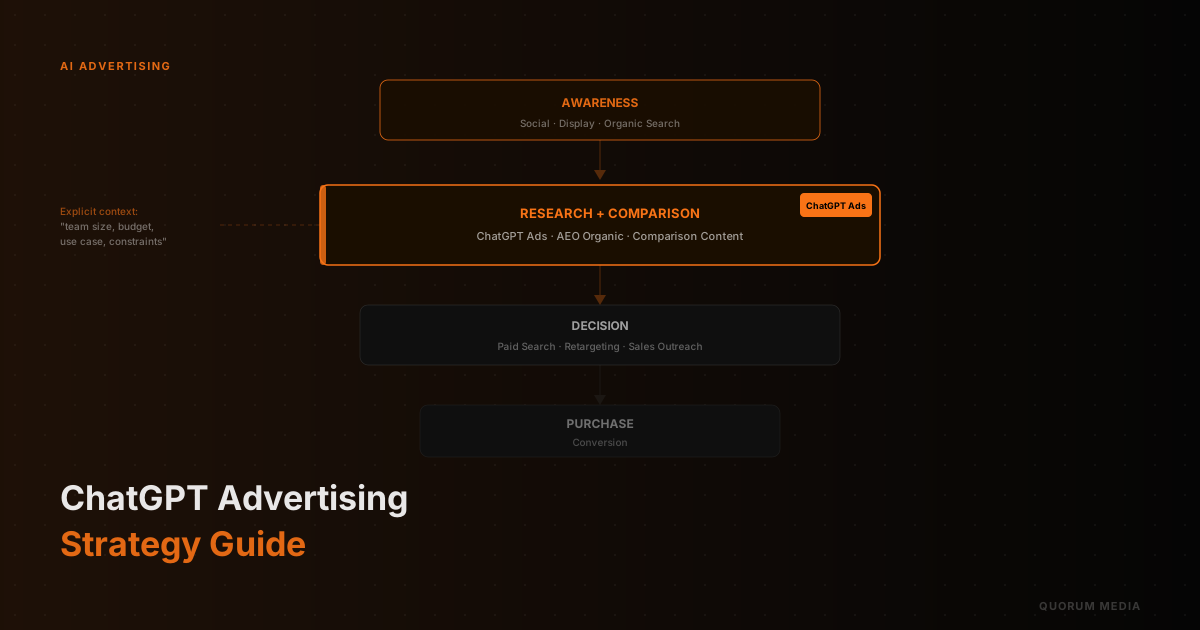
A user who types "CRM software" into Google has revealed almost nothing about their situation. A user who asks ChatGPT "what is the best CRM for a fintech startup with a sales team of eight people handling both inbound and outbound?" has shared their company type, team size, sales motion, and implicit budget range in a single message. That is the qualitative difference ChatGPT Ads is built to exploit.

What Is the Purchase-Intent Signal in ChatGPT Conversations?
Traditional digital advertising operates on keyword proxies. The keyword "accounting software" might indicate purchase intent, or it might indicate a student writing an essay. There is no way to know from the keyword alone.
In ChatGPT, users share explicit context because sharing context produces better answers. A message like "I run a 25-person agency, we bill around $2M annually, and I need to replace our current project management tool because it does not handle resource allocation well" is a full buyer brief, delivered voluntarily, before the first ad impression is even served.
This is a qualitatively richer signal than any keyword proxy. The advertising opportunity is to match your product to the specific conversational contexts where it is the right answer. Mapping those contexts is the foundational strategic work for any ChatGPT ad campaign.
How to Identify Your High-Intent Conversation Moments?
The practical method is to think backwards from the purchase decision. For your product or service, work through these three questions before setting up a single campaign:
What comparison questions does your buyer ask before deciding? These are the clearest high-intent signals. "Best CRM for a fintech startup." "X versus Y for a B2B sales team of ten." "Alternatives to [incumbent tool]." The specific framing your buyers use when comparing options in your category is where your ad needs to appear.
What context do they typically share when asking? Company size, team role, budget range, specific problem to solve, timeline. Understanding the context patterns in your category tells you how detailed and specific your ad copy can afford to be.
What outcome are they trying to reach? A user researching passively behaves differently from one who is comparing two shortlisted vendors before a final decision. The copy and call to action appropriate for each stage are different.
How Should You Structure a ChatGPT Ad Campaign?
OpenAI Ads Manager uses a campaign and ad parameter structure: campaigns hold objectives and budget settings, while ad parameters govern creatives and targeting. The strategic decision is how to segment your campaigns.
The most effective approach is to structure campaigns around intent clusters rather than audience demographics. An intent cluster is a group of related conversation types that share a common buyer stage and decision context. Three broad clusters work for most categories:
- Research-stage queries: "What is the best X for Y?" and "How does X work?" conversations. These buyers are at the top of the funnel. Awareness objectives, brand-building copy.
- Comparison-stage queries: "X versus Y" and "alternatives to Z" conversations. These buyers are shortlisting. Differentiation-focused copy, feature-specific messaging.
- Decision-stage queries: "Is X worth it for a company like mine?" and "What should I ask [tool] before signing?" conversations. These buyers are close to deciding. Conversion objectives, specific social proof, direct calls to action.
Start with a single campaign covering your most valuable intent cluster to gather performance data before expanding. Early data on which conversation contexts produce qualified traffic is more valuable than broad coverage at launch.
How Do You Write Effective Ad Copy for Conversational AI?
Ad copy for ChatGPT is the hardest part of the strategy to get right, and the area where most brands default to the wrong approach. Standard digital ad copy conventions do not transfer.
ChatGPT users are thinking and deliberating. They have initiated a research or decision process and are in an active cognitive mode. An ad that feels like an interruption does not fit that context. An ad that feels like a relevant, well-timed contribution to the decision they are already making does.
Five principles that separate effective ChatGPT ad copy from standard digital formats:
- Lead with the use case, not the brand. "For e-commerce teams managing high-volume returns" outperforms "Introducing [Brand Name]." The use case earns attention from the relevant audience; the brand name alone earns nothing in a conversational context.
- Be specific about the differentiator. "Unlike general project management tools, X is built specifically for creative agencies handling multi-client deliverable tracking" is more persuasive than "the most powerful project tool." Specificity signals relevance; generic claims signal noise.
- Match the register of deliberation. Users in a comparison mode are thinking carefully. Copy that sounds like a TV commercial or a social ad stands out as incongruent. Write for an intelligent buyer who is doing research, not a passive scroller.
- Respect the intelligence of the audience. ChatGPT users are typically high-intent, research-oriented buyers. Oversimplified copy, excessive exclamation points, or vague benefit claims are read as low-quality signals by this audience.
- Test variants by conversation context. The same product may perform differently in different conversation types. A startup founder asking about your tool behaves differently from an enterprise procurement team. Create separate copy variants for distinct buyer contexts and let performance data guide consolidation.
ChatGPT Advertising, managed end to end.
We handle campaign strategy, ad copy, Ads Manager setup, and ongoing optimization for brands advertising on ChatGPT. Integrated with your PR and AEO program.
See the service →How Do You Integrate ChatGPT Ads Into Your Marketing Mix?
ChatGPT Ads does not replace existing channels. It adds a new layer of coverage at a specific point in the buyer journey: the active research and comparison stage. Understanding how it fits with what you already run is the key to allocating budget effectively.
vs. Google Ads: Google captures intent at the search query level. ChatGPT captures intent at the decision-context level. For many high-consideration purchase categories, ChatGPT is where buyers do their structured thinking before they start clicking search results. The channels can be complementary: ChatGPT for the research and comparison stage, Google for the query-to-click conversion stage.
vs. Social Advertising: Social advertising is primarily a discovery and awareness channel. Users on social media are not in a research mode. ChatGPT users are. If your category requires a buyer who is actively investigating options before spending money, ChatGPT is more directly aligned with that moment than social.
vs. AEO and GEO: Answer Engine Optimization (appearing organically in ChatGPT's own answers) and paid ChatGPT advertising are complementary, not competing. A brand that appears both as an organic recommendation and as a clearly labeled sponsored result in the same conversational context has maximum coverage of the AI research channel. Brands investing in AEO should also be evaluating paid ChatGPT placement, and vice versa.
vs. Content Marketing: The research you do to identify high-intent conversation moments for ChatGPT Ads directly informs your content strategy. The specific use cases, comparison framings, and decision contexts that matter in ChatGPT are the same ones that should be addressed in your content. The two programs reinforce each other.
Measuring ChatGPT Ad Performance
The core metrics are familiar from other paid channels: impressions (reach), click-through rate (copy relevance), and conversion rate (landing page and offer quality). OpenAI's Ads Manager provides campaign-level reporting on these, with the ability to edit campaigns and optimize based on performance data.
One additional dimension worth monitoring is conversation context quality. Are your ads appearing in the specific conversation types you targeted? Reviewing the conversion data over time tells you whether the intent cluster you built your campaign around is producing buyers, browsers, or neither. If clicks are high but conversions are low, the issue is often a mismatch between the conversational context where the ad appeared and the buyer stage you were expecting.
Use A/B testing of copy variants to identify which use-case framing performs best within each intent cluster. Start by testing the lead line, which is typically the highest-leverage variable in a ChatGPT ad creative. Once you have a winning lead line, test the differentiator claim, then the call to action.
Should You Work with a Specialist Agency for ChatGPT Advertising?
Managing ChatGPT advertising effectively requires a different skill set from traditional PPC management. The strategic inputs are different: identifying conversation moments requires understanding how your buyers think and what they ask AI, not just which keywords they search. The copy requirements are different: writing for deliberating buyers is a distinct discipline from writing for passive scrollers or search query responses. And the optimization logic is different: intent cluster analysis requires qualitative judgment alongside quantitative metrics.
Agencies with experience in both AI search optimization and paid media are best positioned to manage ChatGPT campaigns well. The same expertise that informs AEO and GEO strategy, understanding how buyers phrase questions to AI systems and what kinds of answers they are looking for, transfers directly to ChatGPT Ads campaign design.
At Quorum Media, our ChatGPT advertising service handles campaign strategy, intent mapping, ad copy development, Ads Manager setup, and ongoing optimization. It integrates with our broader AEO and media placement programs so your brand has full coverage of the AI research channel, both paid and organic. Get in touch to discuss what a campaign looks like for your category.
ChatGPT Ads is a genuinely new advertising surface, and the brands that treat it as simply another PPC channel will underperform. The ones that invest in understanding conversational intent, writing for deliberating buyers, and structuring campaigns around decision stages will reach their audience at the most valuable moment in the purchase journey.