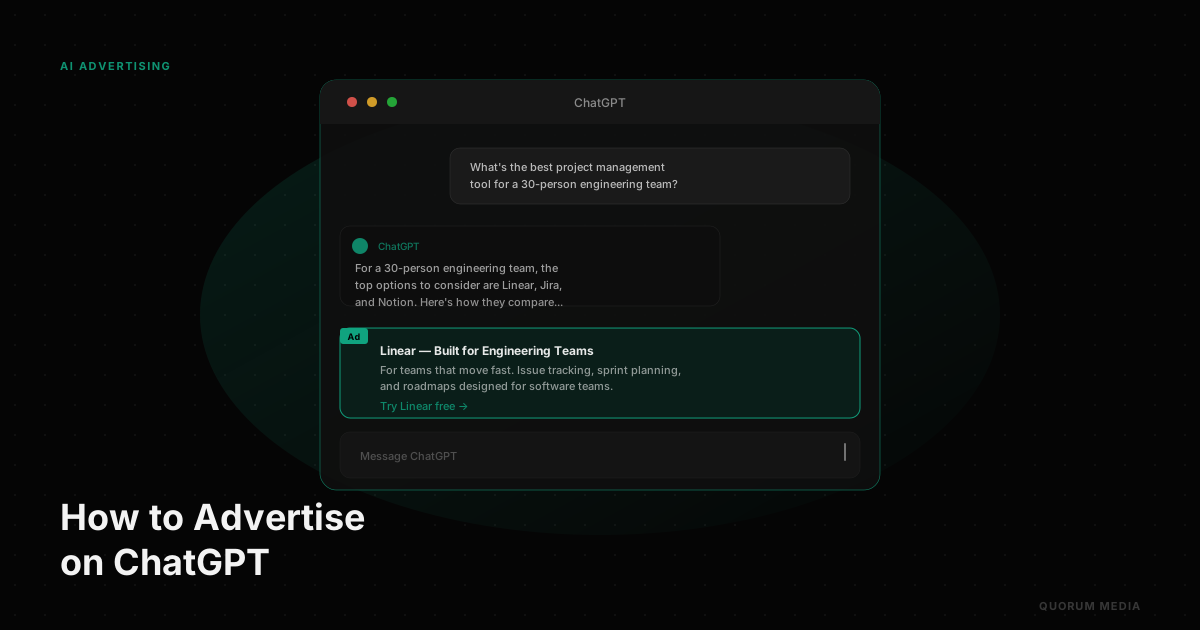
What Is ChatGPT Advertising?
ChatGPT advertising is OpenAI's native ad platform, launched in 2026, that places branded ads within ChatGPT conversations. Unlike search advertising, which targets keywords typed into a search box, ChatGPT ads appear during live AI conversations when users are actively researching, comparing alternatives, and working through purchasing decisions.
When a user asks ChatGPT something like "what is the best project management software for a remote team of 20?" they are not just searching: they are sharing context, constraints, and intent. That richer signal is what makes the platform valuable to advertisers. The ad appears in this high-intent moment, clearly labeled and visually separate from ChatGPT's own response, so users always know what is an ad and what is not.
Early advertisers on the platform include Newegg, Best Buy, Lowe's, and VistaPrint. Alec Shao, Performance Marketing Manager at Newegg, put it plainly: "We want Newegg to be part of the conversation when someone is researching what to buy. Being in ChatGPT helps us shape engagement at that exact moment."

Who Should Advertise on ChatGPT?
ChatGPT ads work best for categories where buyers research before committing. If your customers tend to compare options, read reviews, ask questions, and weigh trade-offs before a purchase, they are likely using ChatGPT as part of that process.
- B2B SaaS and software: Queries like "what is the best CRM for a small sales team" or "Salesforce vs HubSpot for a 50-person company" are exactly the high-intent comparison moments where a well-placed ad can shape a decision.
- Consumer electronics and hardware: Tech buyers are heavy ChatGPT users for comparison research. Appearing when someone is deciding between two laptops or routers is a direct conversion opportunity.
- Professional services: Legal, financial, and consulting services benefit from appearing at the research stage, before users have committed to a provider.
- Home improvement and retail: Lowe's and Best Buy are already running ChatGPT campaigns, signaling that high-consideration consumer categories are a natural fit.
- Any high-consideration purchase: If your average customer spends more than a few minutes researching before buying, they are a ChatGPT audience candidate.
Step 1: Create Your OpenAI Ads Manager Account
Go to ads.openai.com and register. Once registered, you are taken into the Ads Manager interface, where you create and manage all campaigns, access reporting, and find step-by-step setup resources in the Help Center.
OpenAI is currently running a new-advertiser promotion: spend your first 500 euros and receive a matching 500 euro advertising credit. The promotion runs until the end of December 2026, making it a low-risk moment to test the platform with a modest initial budget.
Step 2: Set Up Your Campaign
Inside Ads Manager, creating a campaign involves three core decisions:
- Campaign objective: What you want the campaign to achieve. Options include awareness (reach users during research), engagement (drive clicks and interactions), and conversion (drive specific actions on your site).
- Budget: Set a daily budget or a total campaign budget. ChatGPT's bidding and delivery system allocates spend across relevant conversations based on the parameters you define.
- Targeting: This is where ChatGPT advertising differs from keyword-based platforms. Instead of bidding on specific keywords, you define audience parameters and the intent signals you want to match. The platform uses the richer context of AI conversations to place your ad relevantly. A query about "the best accounting software for freelancers" carries far more context than the keyword "accounting software" alone.
Step 3: Write Ad Copy for Conversational Context
This is where most brands will need to rethink their approach. ChatGPT ad copy is not the same as search ad copy or social ad copy. The user is mid-conversation with an AI, working through a decision. Your ad appears in that context. Copy that feels like an interruption or a broadcast message will be ignored. Copy that feels like a useful, well-timed recommendation will perform.
A few principles that make the difference:
- Match the conversational register: The user is in thinking mode, not scrolling mode. Write like you are speaking to someone who is actively trying to solve a problem, not someone who needs to be grabbed with a headline.
- Lead with the use case, not the brand: "For remote teams managing complex client workflows" is more effective as an opener than "Introducing [Product Name]". The user cares about their situation first.
- Be specific: Vague value propositions are invisible in a context where the AI has just given a thoughtful, detailed response. State exactly what you do and who it is for.
- Earn the placement: An ad appearing alongside a high-quality ChatGPT response should be genuinely relevant. The more specific and useful your copy, the more it fits the context rather than interrupting it.
You upload ad parameters through bulk data upload or configure them directly in the Ads Manager tool. OpenAI's Help Center includes templates and guidance for structuring your creative.
Step 4: Launch and Measure
After setting campaign parameters and uploading creatives, you launch from within Ads Manager. From that point, the platform reports on:
- Impressions: How many times your ad was shown during ChatGPT conversations.
- Engagement: Clicks and interactions with your ad.
- Conversions: Actions taken on your site after clicking, if conversion tracking is configured.
You can edit live campaigns, adjust budgets, and swap creative at any time. OpenAI recommends reviewing campaign performance regularly and iterating on copy based on what is converting. As with any new ad platform, the early weeks of a campaign tend to be a learning phase where the system optimizes delivery and you refine your copy.
Managed ChatGPT ad campaigns for brands.
Campaign setup, ad copy, targeting strategy, and ongoing optimization. We handle the platform; you focus on the business.
See the service →ChatGPT Advertising Best Practices
Based on how the platform works and what the early advertiser data shows, these are the practices that matter most in 2026.
- Align copy to the decision stage. ChatGPT ads reach buyers who are comparing, not just browsing. Your copy should address the comparison moment directly: what makes you different from the alternatives, and why that difference matters for the specific use case the user is researching.
- Test multiple creatives. Contextual targeting means your ad can appear across a range of conversation types within your target category. Different copy variants will resonate differently depending on the specific question a user is asking. Run multiple versions and let the data show which performs best.
- Run alongside your existing campaigns, not instead of them. ChatGPT ads capture a different moment in the buyer journey than Google Search or social. A user might see your Google ad when they search a keyword, then encounter your ChatGPT ad when they ask a follow-up question. The channels are complementary, not competing.
- Match your landing page to the intent. A user clicking from a high-intent ChatGPT conversation about, say, "the best HR software for a company with part-time staff" expects a landing page that speaks to their situation. A generic homepage loses the click. Build or link to pages specific to the use case you are targeting.
- Layer in AEO alongside paid. Answer Engine Optimization builds organic presence in ChatGPT responses over time. Running paid ChatGPT ads gives you immediate visibility; AEO builds the underlying authority that determines whether you appear in organic responses when no ads are running. The two reinforce each other.
Working with a ChatGPT Advertising Agency
Managing ChatGPT campaigns effectively requires a different skill set from traditional PPC. The copy conventions are different: writing for conversational AI context means understanding how users interact with AI assistants, not just how they scan search results pages. The targeting logic is different: intent signals based on conversation context require a different strategic framework than keyword bidding. And the optimization loop is different: reading campaign data from a new platform and translating it into actionable creative decisions requires experience with the platform's specific mechanics.
A specialist ChatGPT advertising agency handles setup, creative, targeting strategy, and ongoing optimization, freeing your team to focus on the business decisions rather than the platform mechanics. Ideally, that agency also integrates ChatGPT paid advertising with a broader AI visibility strategy: AEO, GEO, and organic presence across AI platforms alongside the paid layer.
At Quorum Media, our ChatGPT advertising service covers campaign setup through to ongoing optimization, integrated with our broader AI visibility and reputation work. If you want to talk through your brand's fit for the platform, get in touch.
ChatGPT advertising gives brands access to buyers at the highest-intent moments in the research process: when they are actively comparing, questioning, and deciding, rather than passively scrolling. The platform is new enough that early movers have a meaningful advantage in learning its dynamics before it becomes as competitive as Google Search. The setup is straightforward; the differentiation is in the copy and the strategy behind it.